
Performance Plastics are Engineering the Future of Medicine
luoropolymers in Medical Devices: Applications and Critical Properties
These miniature systems operate on the microscale, transporting tiny volumes of liquid through channels only micrometers wide. Ensuring accuracy and sterility in such environments demands materials capable of maintaining purity under mechanical, chemical and thermal stress — and fluoropolymers deliver.
They’re the unsung heroes of everything from targeted drug delivery to advanced diagnostics. Few materials match the synergistic performance of the fluoropolymer family across all these critical parameters.
Examples aremicropumps, which are engineered to move minuscule quantities of fluid or gas with extreme precision. Widely adopted in biomedical and high-tech fields, these devices form the heart of microfluidic systems and demand chemically inert, flexible materials that won’t contaminate or degrade under rigorous use.
Shared performance advantages include:
- Biocompatibility
- Safe for short- and long-term biological contact
- Compliant with standards like ISO 10993-5 and ISO 13485
- Low Surface Energy (<36 dynes/cm)
- Prevents fluid adhesion
- Ensures smooth, laminar flow in drug delivery and reagent transport
- Low Leachables
- Minimal release of substances like DEHP or BPA
- Enhances patient safety and pharmaceutical integrity
What sets them apart:
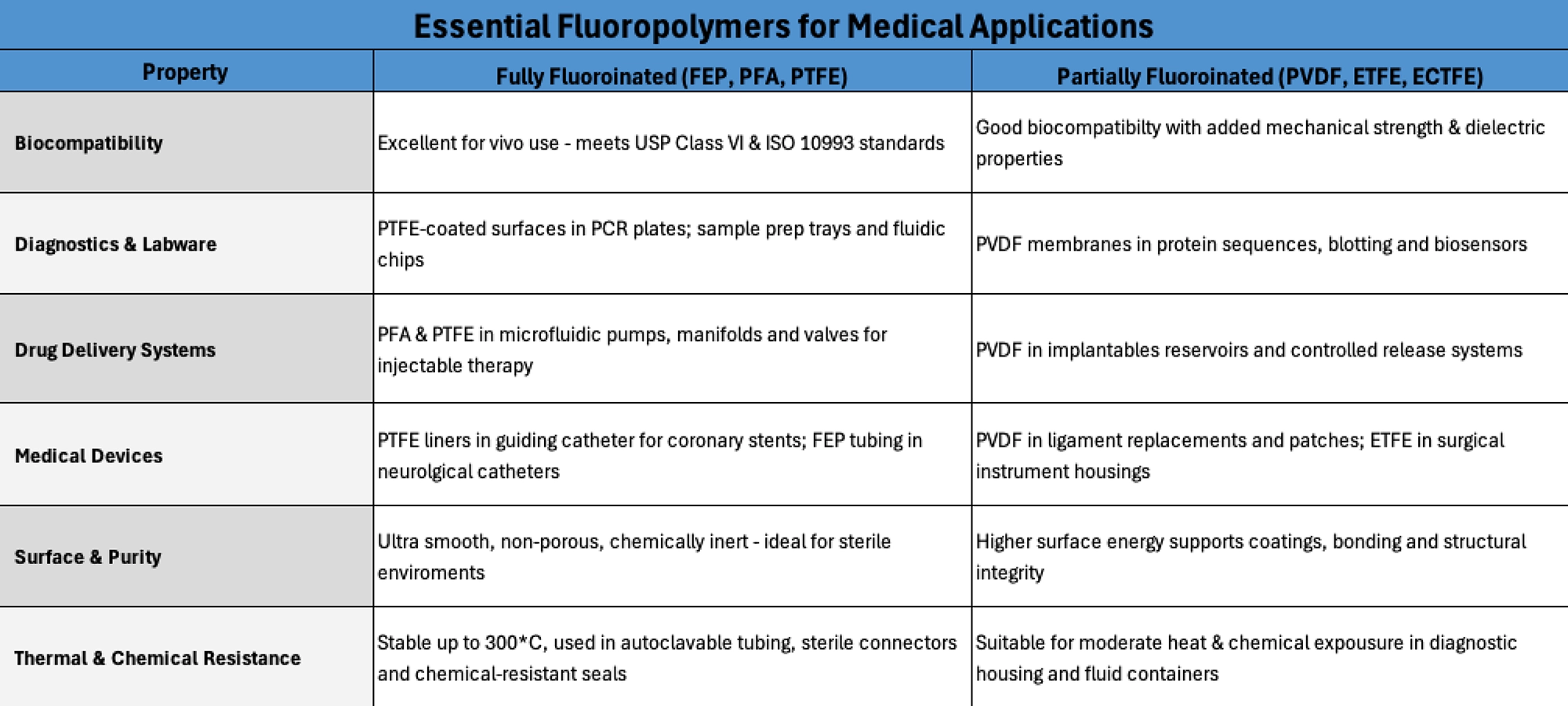
- Fully fluorinated types (PTFE, PFA, FEP)
- Exceptional chemical resistance and ultra-low porosity
- Preferred for applications requiring ultra-high purity and contamination control
- Partially fluorinated types (PVDF, ECTFE)
- Strong dielectric behavior and mechanical rigidity
- Higher surface energy allows better adhesion for coatings and structural integration
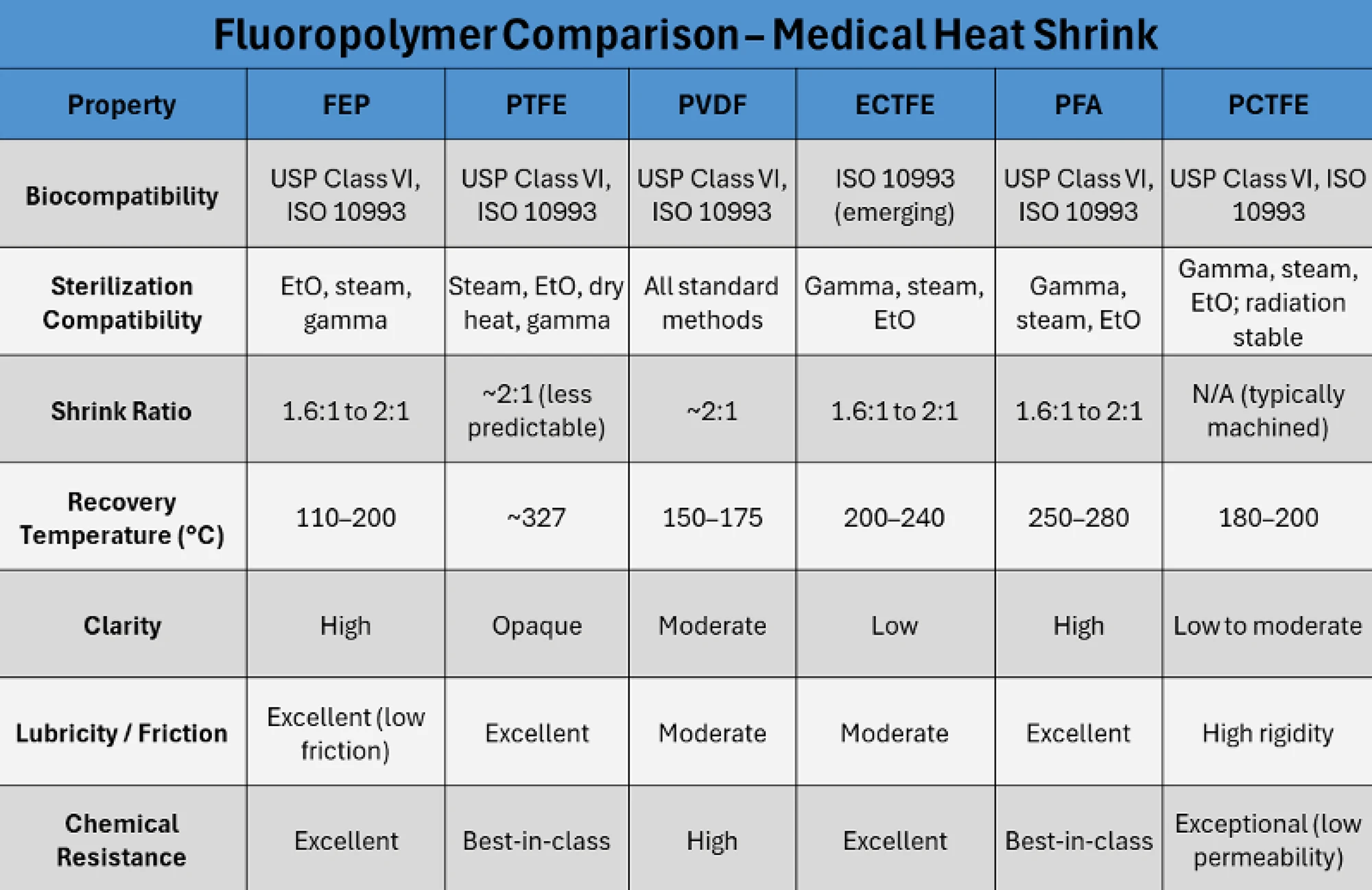
In addition to previously noted properties — biocompatibility, low surface energy and minimal leachables — heat shrink tubing offers the following:
- Exceptional Lubricity (Low Friction Surface)
- Facilitates smooth insertion and withdrawal of catheters and introducers
- Reduces tissue trauma and procedural time
- Precise Heat Shrink Capabilities
- Shrinks uniformly around complex device geometries
- Provides secure encapsulation and integration with hybrid materials
These attributes make heat shrink tubing not just a protective barrier — but a performance enhancer. It streamlines device navigation through biological systems, supports procedural accuracy, and contributes directly to improved patient outcomes.
- Precision and Repeatability
- Achieves complex shapes with consistent tolerances across high volumes
- Mitigates machining issues like deformation from thermal expansion
- Scalability and Cost-Efficiency
- Economical in large production runs despite high tooling costs
- Minimizes waste and labor compared to subtractive methods
- Cleanroom Compatibility
- Supports ISO 7/8 manufacturing for sterile medical components
- Reduces particulate generation versus machining
- Sterilization Resilience
- Molded parts withstand EO, gamma, steam and dry heat sterilization
- Maintain mechanical integrity without requiring post-processing treatments
- Design Flexibility
- Enables overmolding, insert molding and multi-shot configurations
- Facilitates ergonomic designs and integration of sensors or hybrid materials
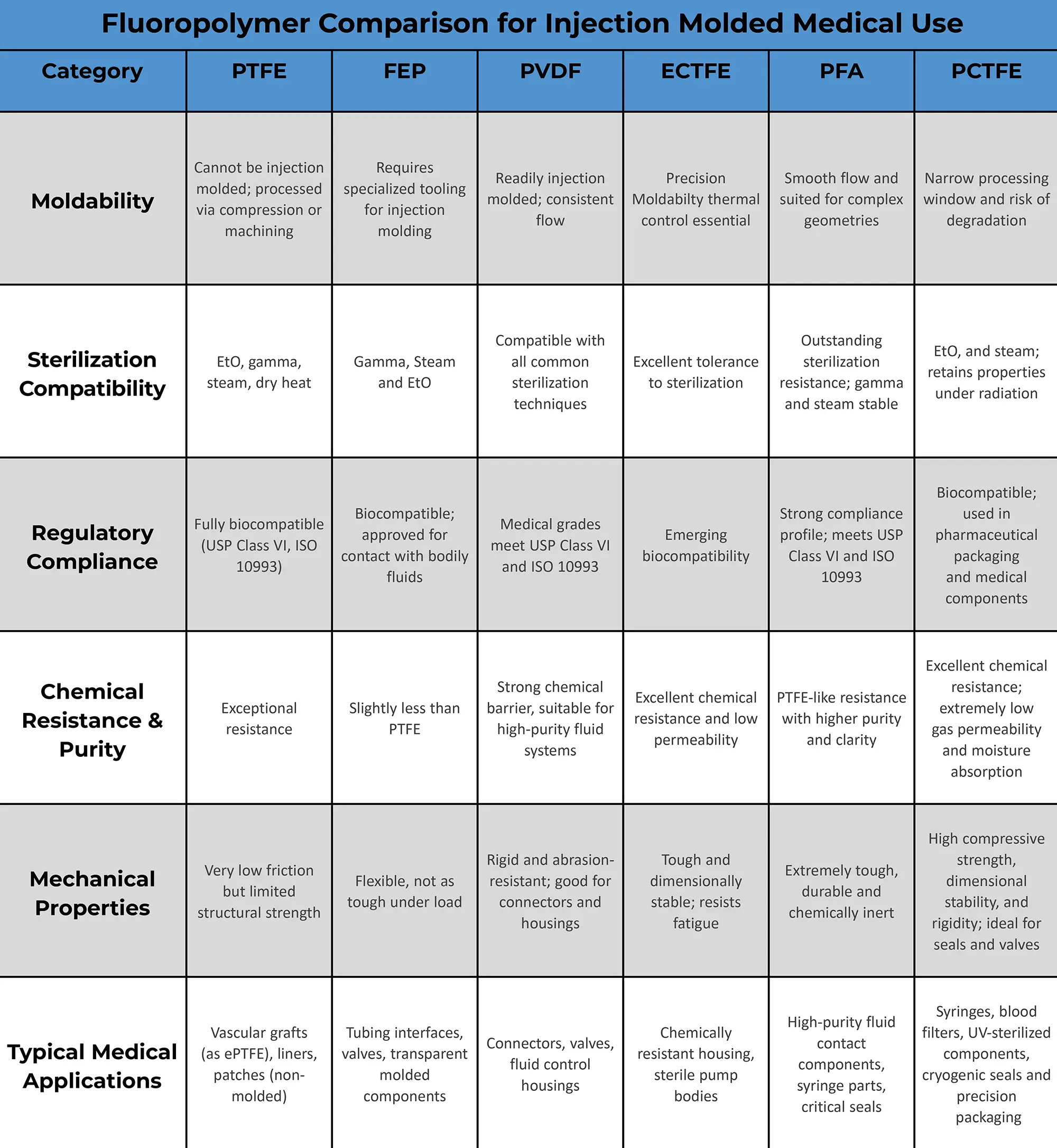
Compared to machining, which is limited to shaping and subtracting from stock, injection molding enables transformative design freedom, true scalability and enhanced performance.
For performance plastics professionals, this is a pivotal moment to lead the charge—by formulating specialized compounds, pioneering advanced molding techniques, and partnering across the healthcare supply chain. In a world where purity, reliability, and clinical performance are non-negotiable, fluoropolymers aren’t just facilitating progress.
See chart below for more information.