

SpecialFocus
How One Small Distributor Keeps Plastic Scrap Out Of The Landfill in Colorado
olorado Plastics, founded in 1969, is a single location small distributor and fabricator located in Louisville, Boulder County, CO USA.
Colorado Plastics has been owned since 2005 by Drew and Anita Schwartz. Drew works full-time operating the business while Anita continues her career outside the business as a full-time environmentalist. Her work focuses on convincing fossil fuel project funders that climate change is real and that they should really consider the ROI on renewable energy projects instead.
Colorado Plastics has come up with a combination of two low-cost methods for keeping our performance plastics scrap out of the landfill. The first is selling the usable scrap as remnants, the second is giving away the hard to sell scrap.
Remnant Sales
Many shoppers who buy performance plastic remnants for their own use don’t know exactly what they’re looking for. In a similar sense, they don’t usually have strict or well-defined requirements for the scrap that they’re interested in. They know that they want to save money and they usually know the color they want, but beyond that, there’s often a lot of ambiguity and flexibility in what they can use. One way to overcome the requirement ambiguity is to let the scrap buyers shop for remnants in our warehouse.
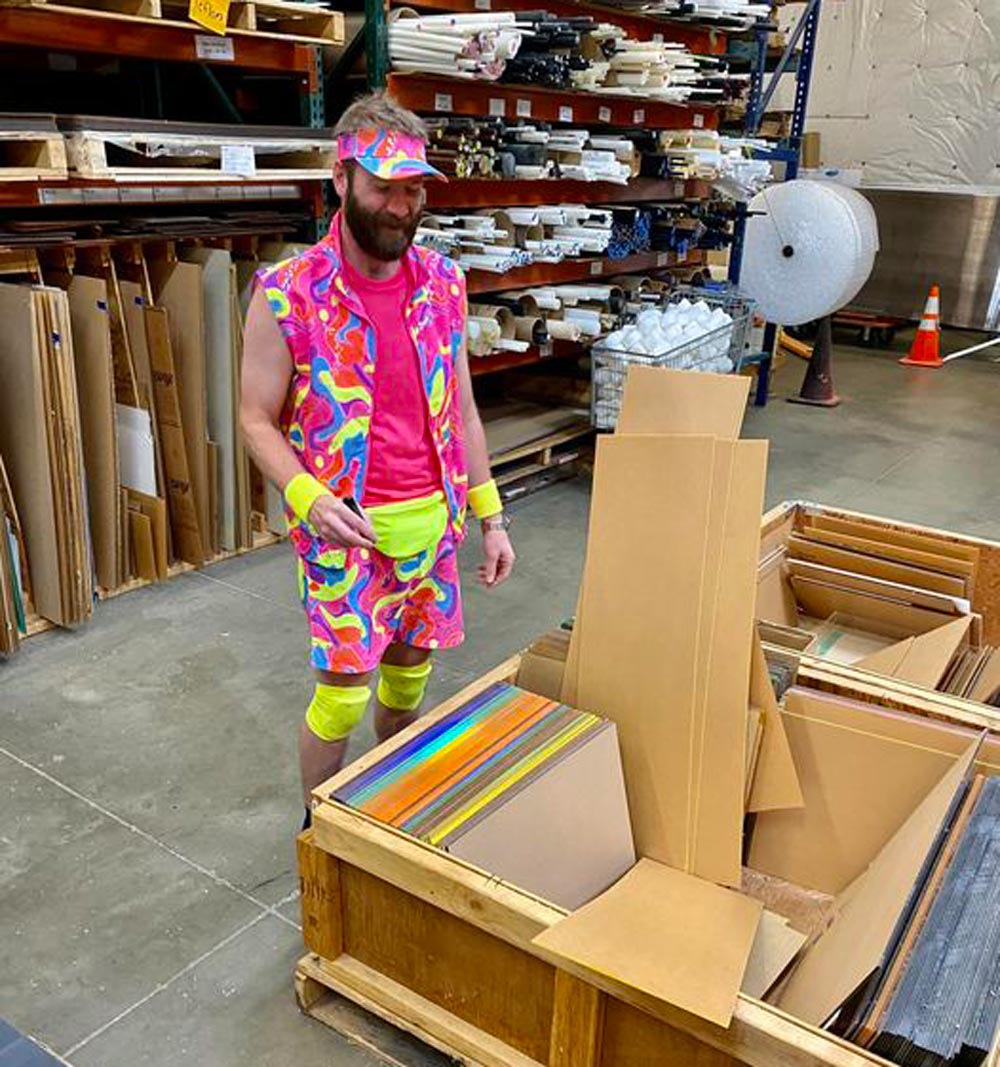
We used to sell remnants by the pound daily until the COVID-19 pandemic hit in March 2020. About 12 years before the pandemic, we started holding a once-a-month Fourth Friday Half-Price Remnant Sale. That sale continues, but now each fourth Friday of the month is the only day when we permit performance plastics shopping in our warehouse, with the exception of November and December when we move the Remnant Sale up to the third Friday of the month because of the Thanksgiving and Christmas holidays.
The full price per pound at which we sell remnants is published on our website and another page on our website gives instructions for calculating the weight of a given remnant by using the number of square feet and the thickness for that remnant. When we are selling the remnants, we have a scale in the warehouse where we weigh the customer’s selections and then hand them a weight ticket. After that our employees at the cash register can calculate the total purchase price.
We also remind remnant shoppers through our website and in our social media posts that the determination of what pieces of which materials in our warehouse are eligible for sale as remnants (and particularly the ones for sale at half-price) is 100% at our discretion. We tell the shoppers that in general, remnants are less than 17 inches wide and less than 48 inches long. However, depending on the supply of scrap we have to sell, that rule is often waived.
Another way that we frame the remnant shoppers’ expectations about what is available is by posting links to a short video of a typical remnant sale selection in our ads, website and social media posts about the sale.
We have also periodically used one-hour free ice cream or free specialty coffee trucks to promote the Remnant Sale.
The Free Box
When the supply of remnants begins to exceed the storage capacity of our remnant rack, we take the smallest and most irregular pieces outside to an area that we call the Free Box next to the driveway behind our building.

The Free Box began in 2005 when Drew and Anita bought the business and were cleaning out 35 years of remnants that seemed to be unsaleable. One day Drew advertised the Free Box on Craig’s List, and the amount of material in the Free Box plummeted within a week. One result of the Craig’s List posting was that a number of artists, students and teachers who relied on the box for art supplies began to remark to us that the box no longer seemed to have the same quantity (and quality) of scrap plastics in it anymore. Now, we rarely post the Free Box on social media unless it is overflowing, and when we do tell visitors about it, we urge them to think of the Free Box as sort of a club or a cooperative that needs to be respected and protected for the select few that know about it.
The Free Box is available to the public 24/7. In addition to freeing up space in our indoor remnant storage racks, the Free Box serves to help our counter salespeople by giving them a way to persuade day to day walk-in customers to take a look at the Free Box as a way of getting started on their performance plastic selection process. Many times, these customers don’t want to spend much money anyway; but they do seem to want to spend a lot of our salespeople’s time discussing their project — especially how to design and fabricate their project.
I am convinced that neither the Remnant Sale nor the Free Box cannibalize sales. On the contrary, they each actually seem to increase interest in other types of materials and the ways in which we sell them. Possible reasons for this include:
- There’s rarely anything exactly like what typical corporate buyers purchase in the Free Box or Remnant Sales
- Corporate buyers aren’t normally asking for “while you wait service”
- Normal buyers don’t usually know about our Free Box
- Social media posts about the Remnant Sale are an effective part of our marketing communications mix
- Remnant shopping sometimes leads to fabrication service sales
Drew is happy to take calls or emails from anyone who wants to learn more about how we use Remnant Selling and Free Boxing to keep plastic scrap out of the landfill.