

PlasticsWatch
s semiconductor devices continue to shrink and grow more complex, fabrication processes face increasing demands for precision, consistency and yield. One critical step is chemical mechanical planarization, or CMP, where wafer-level defects can affect device performance, yield and cost of ownership.
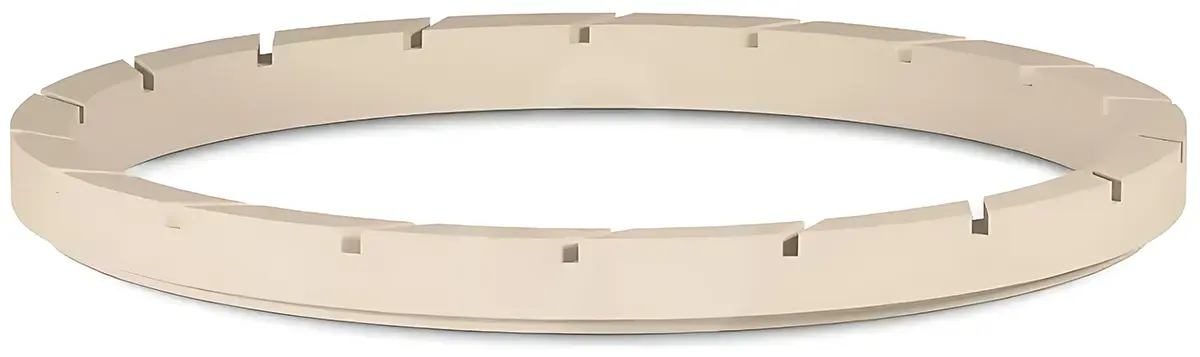
While much of the industry’s research has focused on consumables such as polishing pads, slurry and conditioners, retaining ring materials are receiving greater attention for their influence on CMP performance. The retaining ring can affect pad wear, pad micro-texture, debris generation and overall process stability.
Ensinger offers a portfolio of materials engineered for CMP retaining rings, including TECATRON CMP natural and TECAPEEK CMP natural. These semiconductor-grade materials are designed to support longer life, fewer defects and more consistent performance in demanding CMP applications. Ensinger also says its optimized stock shapes help improve machining efficiency and reduce waste.
In cooperation with an independent laboratory, Ensinger evaluated the performance of different polyphenylene sulfide, or PPS, retaining ring materials during interlayer dielectric planarization. The findings were published in the Electrochemical Society Journal of Solid State Science and Technology in a technical article titled “Tribological, Thermal, Kinetic, and Pad Micro-Textural Studies Using Polyphenylene Sulfide CMP Retaining Rings in Interlayer Dielectric Chemical Mechanical Planarization.” In the study, the product identified as TECATRON SE is the former name of TECATRON CMP.
Results showed that retaining ring material selection can influence pad surface condition, fragment generation and asperity structure, all of which are associated with wafer-level defect potential and material removal rates. Compared with the industry-standard PPS material, TECATRON CMP generated lower levels of pad fragments and shavings, showed less obscured pores and entrained debris, and produced sharper asperity tips on the pad surface.
Those pad surface characteristics suggest the potential for fewer wafer-level defects and improved material removal rates. Both retaining ring materials produced comparable pad wear rates. TECATRON CMP appeared to wear faster than the industry-standard PPS ring, but that difference was considered insignificant in high-volume manufacturing because pads are changed regularly and retaining rings are typically replaced after a set number of pad changes, depending on the application.
The findings also showed that PPS retaining rings from different suppliers can affect pad micro-texture in different ways. Ensinger says TECATRON CMP natural was developed specifically for CMP retaining rings and optimized to condition pads in a way that may help reduce microscratches and wafer-level defects. In advanced semiconductor manufacturing, improvements in defect control and yield can have a meaningful effect on process performance and cost of ownership.
For more information visit www.ensingerplastics.com