

Unlocking the Potential of Thermoset Polyurethane Elastomers:
Unique Sterilization and Antimicrobial Properties in the Medical Industry
n the fast-evolving world of medical devices and healthcare technology, materials that combine durability, biocompatibility and resilience under harsh sterilization methods are in high demand. Thermoset polyurethane elastomers (PUEs), often overshadowed by their thermoplastic counterparts, are emerging as a superior class of materials offering exceptional performance under sterilization stress and novel antimicrobial capabilities. Their growing relevance in surgical tools, implantable devices, diagnostic systems and wearable medical technologies is no coincidence.
This article explores the unique sterilization resistance and inherent or engineered antimicrobial performance of thermoset polyurethane elastomers—and why they are quickly becoming indispensable to medical manufacturers seeking longevity, compliance and performance in demanding environments.
Polyurethanes are widely used across industries, but thermoset PUEs differ significantly from thermoplastic polyurethanes (TPUs) in both structure and performance.
Whereas TPUs can be remelted and reshaped, thermoset PUEs are chemically crosslinked during curing, resulting in a three-dimensional, irreversible network. This structural distinction gives thermoset PUEs:
- Higher thermal stability
- Better chemical resistance
- Superior mechanical resilience under cyclic stress
- Enhanced performance under sterilization exposure
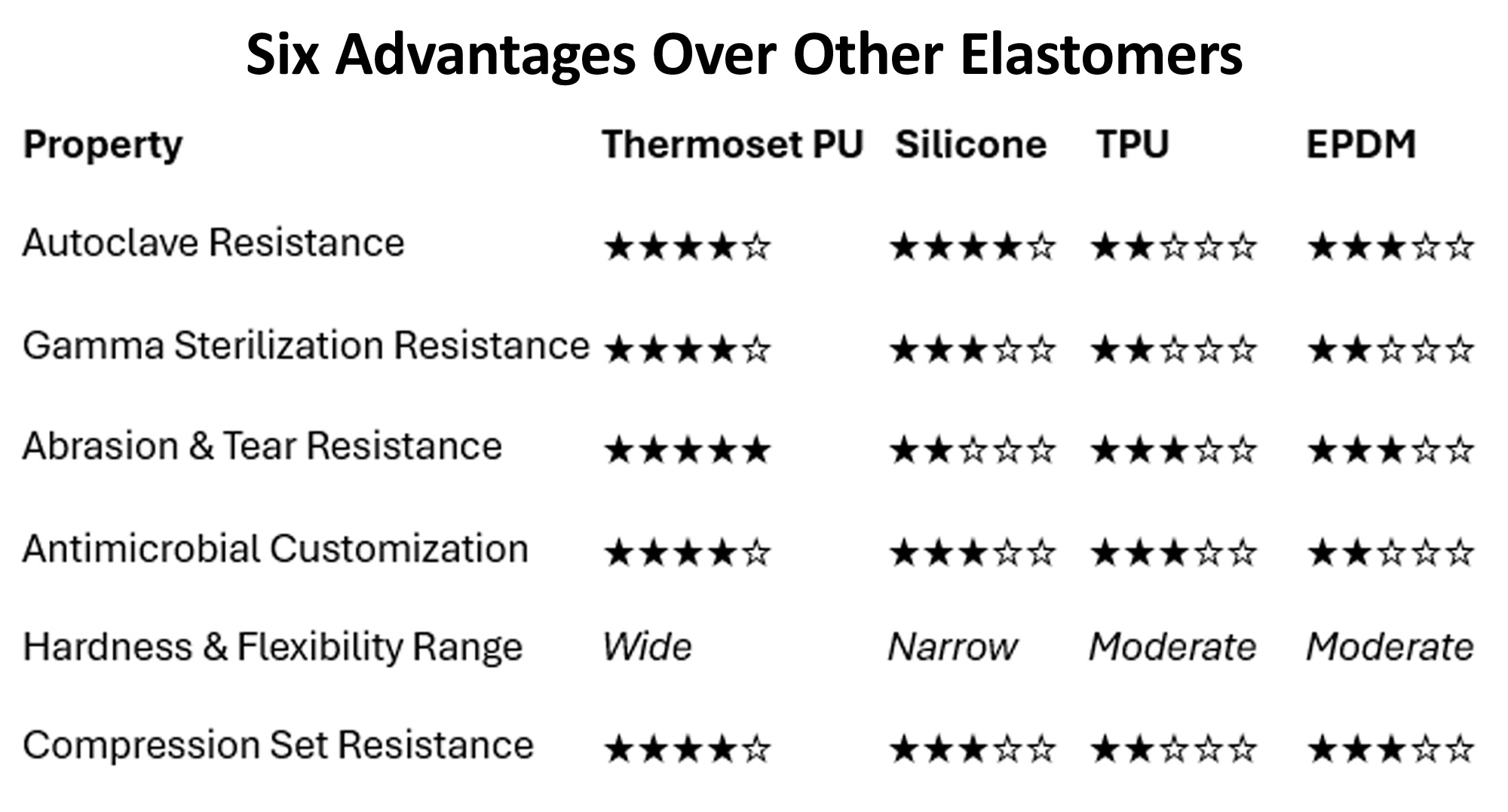
Moreover, thermoset polyurethanes can be engineered across a wide hardness range (30A to 85D), and offer excellent flex-fatigue, abrasion resistance and low compression set, all of which are vital for components used in critical healthcare environments.
- Autoclaving (steam sterilization at 121–134°C)
- Ethylene oxide (EtO) gas sterilization
- Gamma radiation (25–50 kGy)
- E-beam or electron beam sterilization
- Hydrogen peroxide plasma (low-temperature gas plasma)
These processes are harsh on materials, often causing:
- Embrittlement or softening
- Color degradation
- Loss of mechanical integrity
- Surface cracking or delamination
Traditional TPUs, silicones and polyolefins often suffer from degradation under gamma or high-temperature steam. This is where thermoset polyurethanes shine.
Thermoset PUEs can be formulated to resist autoclave cycles up to 135°C without significant degradation in hardness or tensile strength. Chain orientations that promote density play a key role in withstanding repeated high-temperature cycles.
Radiation Resistance
Whereas many plastics degrade or discolor under gamma irradiation, thermoset PUEs — show excellent resistance to radiation-induced breakdown. Aromatic systems may yellow but maintain mechanical properties better than many commodity plastics. Some additive colors can furth its resistance.
Post-cure thermoset systems have lower risk of monomer migration, plasticizer leaching, or degradation byproducts. This minimizes cytotoxicity and contamination in sterile environments, an increasingly important concern for FDA Class II and III devices.
Dimensional Stability
Under repeated sterilization, dimensional accuracy can degrade in many traditional materials. Thermoset PUEs maintain tight tolerances and form retention, especially important for gaskets, seals, surgical tool grips and diagnostic housings.
Incorporation of Antimicrobial Additives
Thermoset polyurethane can be loaded with:
- Silver ions or nanoparticles
- Zinc oxide or copper compounds
- Quaternary ammonium salts
- Organosilane-based antimicrobials
These agents either leach slowly from the surface or act as contact biocides, disrupting microbial membranes. The crosslinked matrix slows diffusion and offers controlled, sustained release profiles.
Non-leaching Surface Modifications
Reactive surface grafting techniques can bond antimicrobial moieties directly into the polymer backbone, preventing leaching and maintaining permanent biofilm resistance. This is valuable in implantables, catheters and long-term-use equipment.
Smoothness & Hydrophobicity
Thermoset PU coatings can be engineered to resist bacterial adhesion through low surface energy and high hydrophobicity. Some variants mimic Lotus-effect surfaces, making it difficult for microbes to anchor and multiply.
Catheter and Endoscope Components
With tight tolerances, chemical resistance, and surface clarity, thermoset PU liners or distal tips offer bio-inert pathways that can withstand sterilization.
Diagnostic and Analytical Devices
Lab-on-chip modules, flexible diagnostic seals, and microfluidic ports benefit from low extractables and sterilization durability.
Surgical Grips and Handles
Textured, ergonomic handles made from 70A–95A PUEs offer resistance to repeated steam/gamma cycles and glove-friendly grip, especially under blood or saline exposure.
Implantable Device Components
Select medical-grade thermoset PUs show long-term biostability and hemocompatibility, suitable for leads, sleeves and encapsulants.
Antimicrobial Pads, Seals and Mats
Molded antimicrobial PU mats are used in operating rooms, diagnostic tables and sterile field dividers, leveraging both mechanical durability and built-in microbial resistance.
While promising, thermoset PU use in medical settings requires:
- Precision tooling for cast molding. Tooling is less expensive than a traditional injection mold but can still be a significant investment depending on design complexity.
- Post-curing protocols to ensure full crosslinking and leachables control
- Material traceability and lot certification for regulatory compliance
- Careful additive selection to balance antimicrobial efficacy and biocompatibility
Their tunable chemistry, crosslinking architecture, and ability to integrate antimicrobial functionality offer a unique trifecta that aligns with FDA regulations, hospital performance needs and patient safety requirements.
Expect increased usage in:
- Wearable biosensors and patient monitoring tools
- Advanced wound care materials
- Surgical robotics
- Drug delivery enclosures