

Engineered Thermoplastics for Semiconductor Cleanrooms:
Meeting Cleanliness and Performance demands
Semiconductors
by Ian Donohue, SEKISUI KYDEX, LLC
n semiconductor manufacturing, the pursuit of ever smaller and more powerful devices has made controlling contamination a key priority. Cleanrooms form the backbone of this effort, and the materials chosen for their construction and outfitting are crucial for maintaining the necessary cleanliness. The standards for semiconductor cleanrooms are strict. ISO 14644 classifications, which specify the maximum allowed particle counts, are just the starting point. Material manufacturers must ensure their products do not shed particles, outgas, or generate static. They must also endure repeated cleaning with aggressive agents and disinfectants, such as PDI disinfectant wipes, while maintaining their structural integrity and appearance. These requirements apply to every surface and component, from large wall panels to the smallest tool covers.
When the right thermoplastic is used, it can offer a combination of properties that make them ideal for semiconductor cleanrooms:
- Non-shedding surfaces: Unlike painted metals or composites, thermoplastics provide smooth, sealed surfaces that resist particle generation.
- Chemical resistance: Thermoplastics can withstand aggressive cleaning agents and process chemicals, ensuring longevity in harsh environments.
- Dimensional stability: Materials like polyetheretherketone (PEEK) and polyetherimide (PEI) maintain structural integrity under thermal cycling, critical for precision equipment.
- Static control: ESD-safe grades of PEEK and other polymers help prevent electrostatic discharge, protecting sensitive electronics.
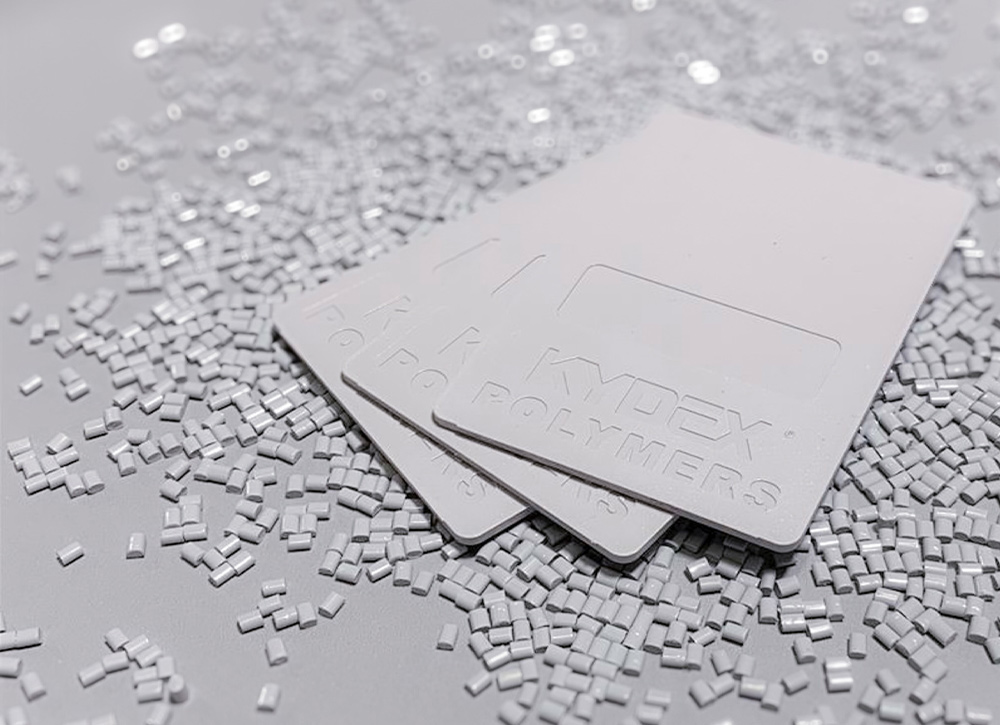
KYDEX® injection molding resin with thermoplastic sheet. KYDEX® sheets are made from domestically sourced material that does not rely on plasticizers, offering inherent antifungal and antibacterial properties while being free of BPA, PFAs and all phthalates, including DEHP.
Thermoplastic sheet manufacturers continue to advance sustainable material solutions for the next generation of product design. Many suppliers now offer portfolios that include injection-molding resins and flame-retardant rigid PVC sheets engineered for chemical and stain resistance. Newer formulations are produced without added plasticizers, resulting in materials that offer inherent antifungal and antibacterial characteristics and are free of BPA, PFAS and phthalates. These thermoplastic solutions are developed to address industry needs for reliable, compliant and easy-to-clean materials used in applications such as cleanroom furniture, wall systems, tool covers and equipment housings.
Thermoplastics are used extensively across cleanroom infrastructure and equipment, each of which demands its own tailored approach to material selection, balancing performance, cost and compliance.
- Furniture and wall protection products: Panels are standard in modular cleanroom walls and workstations. Their smooth surfaces simplify cleaning and resist chemical attack, while their lightweight nature aids installation.
- Tool covers and equipment housings: Thermoplastics are selected for housings exposed to heat and chemicals.
- Precision fixtures: Materials provide dimensional stability for testing and inspection equipment, where tolerances are critical.
From wall protection products and furniture to environments that require impact resistance or unique aesthetics, there are a variety of thermoplastic sheet and resin options ideal for sterile, high-traffic areas and components subjected to frequent handling, such as tool covers and movable equipment housings. It is also suitable for applications needing small, intricate parts. In cleanroom and controlled environments, advances in surface-embedded imaging technologies now allow equipment housings and wall panels to incorporate functional graphics, safety instructions, or visual identification cues without compromising cleanliness standards, material strength or long-term durability.
However, it is the responsibility of material manufacturers, fabricators and distributors to play a crucial role in guiding customers through these considerations. They must ensure that every component supports contamination control, operational safety, and is the most sustainable choice. This includes selecting material suppliers that utilize domestically sourced PVC/acrylic technology without plasticizers and has an in-house recycling program focused on recovering materials from extrusion, thermoforming and end-use applications.

Infused Imaging™, a proprietary process that embeds imagery into KYDEX® Thermoplastics.
The use of thermoplastics in cleanroom furniture, wall systems, tool covers, and equipment housings reflects a commitment to meeting the evolving needs of the semiconductor manufacturing industry. By focusing on material science, compliance and sustainability, manufacturers can provide thermoplastic solutions that help maintain the purity and performance required by semiconductor cleanliness standards.