

News
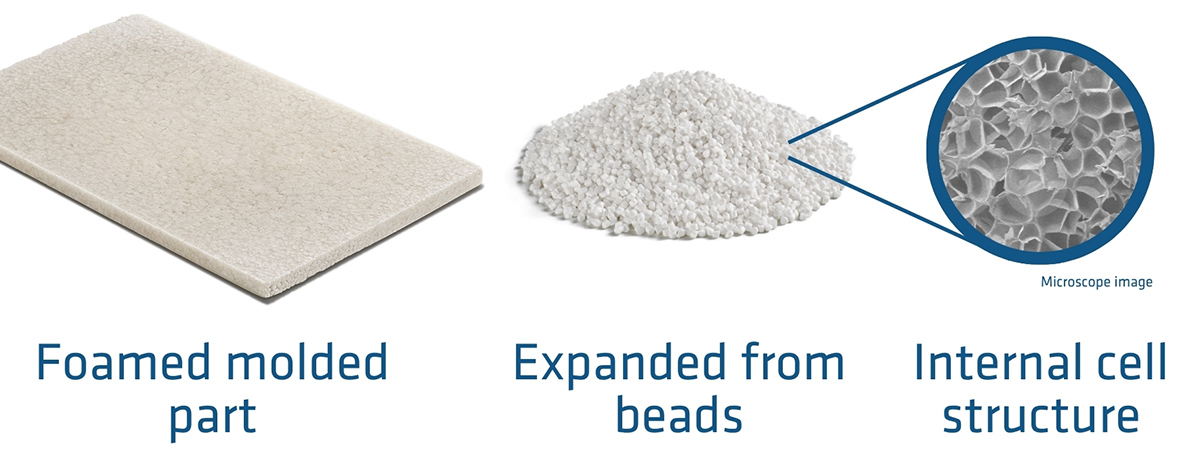
Produced through an energy-efficient manufacturing process, the foams feature a fine, homogeneous cell structure with density and material properties that can be tailored to customer requirements. Depending on the base polymer, the materials can withstand temperatures up to 300°C and exhibit strong resistance to oils, greases, cleaning agents and solvents. These properties make them suitable for lightweight structural components, impact-resistant parts and applications requiring long-term durability in chemically aggressive environments.
The product line is currently in the pilot phase, with beads in multiple densities and foam sheets available in sample sizes for development and testing. Ensinger also offers engineering support and the ability to develop custom-molded parts for project-specific applications.
For more information, visit ensingerplastics.com/en/particle-foam.
Purdue University’s ADDITIVE3D simulation platform was used to virtually model the printing and post-processing stages, including temperature evolution, heat treatment and anisotropic shape compensation. This predictive capability supports improved process reliability and dimensional accuracy for large composite tooling.
Following printing, the University of Sheffield’s Advanced Manufacturing Research Centre performed precision machining to integrate sensor channels, blade root locator mounts and resin flow features. The resulting tool enables single-shot infusion of carbon fiber reinforcement around a polycarbonate core and stainless-steel root, creating a lightweight blade structure with enhanced efficiency.
The blade incorporates embedded sensing technologies — fiber optics, strain gauges, thermocouples and accelerometers — to support real-time monitoring during manufacturing and operation. Testing will continue at the University of Edinburgh’s FastBlade facility before upcoming sea trials, providing data on performance, durability and environmental loading. The project demonstrates how additive manufacturing innovations can accelerate the development of renewable tidal energy systems.
For more information, visit thermwood.com.
