


The Marine Donut is the world’s largest thermoplastic structure made from 600 metric tons of PE100-RC sheet and pipes by AGRU, America, Inc. Credit: Bluegreen AS
The Norwegian company Bluegreen AS has successfully implemented a groundbreaking aquaculture project, the Marine Donut. This closed floating fish farming system, made from the highly crack-resistant plastic PE 100-RC, was installed on a salmon farm owned by SalMar in Norway. This innovative facility, whose PE 100- RC components were supplied entirely by AGRU America, Inc., could be the beginning of a new era of sustainability in salmon farming.
With an outer diameter of 180 feet, a height of over 55 feet, and a total weight of around 660 tons, the Marine Donut is the world’s largest thermoplastic structure. The unique design of this floating fish farm has the potential to revolutionize salmon farming.
The design of the Marine Donut creates a controlled environment that reduces stress for the fish and allows them to grow healthier. Due to its sustainability and cost-efficiency, this solution is intended to replace traditional net cages. The Marine Donut can accommodate up to 200,000 salmon weighing 5.5 pounds each, which remain in the facility until they reach their harvest weight of about 12 pounds.
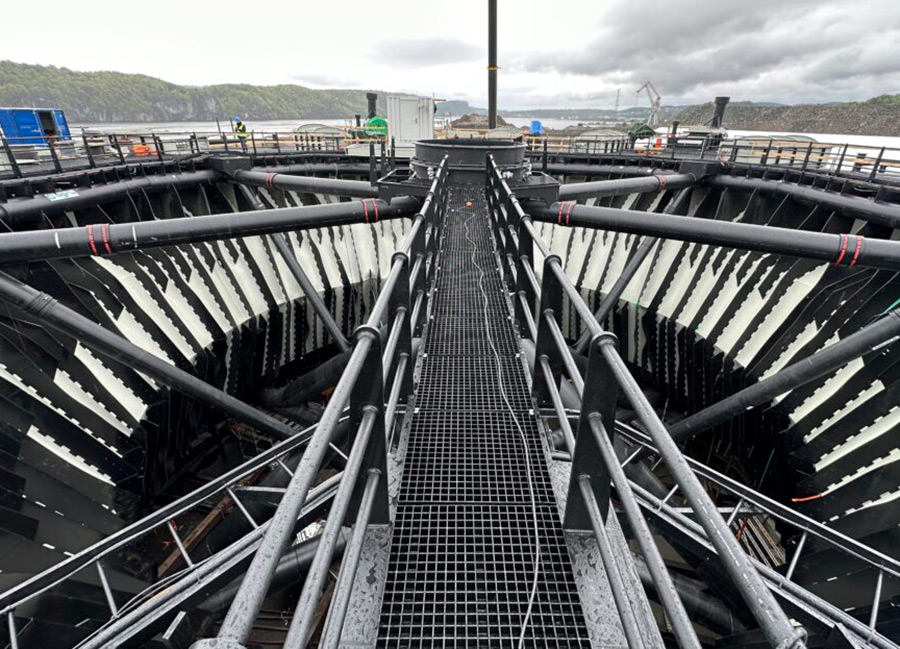
AGRU America, Inc. supplied approximately 600 tons of sheets and pipes made from crack-resistant plastic PE 100-RC. Credit: AGRU America, Inc.
The enclosed structure of the Marine Donut allows for the protection and maintenance of salmon health by shielding them from parasites such as sea lice. The introduction of filtered deep water prevents the incursion of salmon lice. Inside the facility, food residues and fish excrement are collected as sludge and pumped to land for environmentally friendly disposal. This process not only minimizes the environmental impact of salmon farming but also prevents the spread of diseases.
Another noteworthy feature of the Marine Donut is the use of an artificial current channel that simulates the flow of a river around the ring-shaped structure of the facility. As a result, the fish are constantly moving, which positively affects their health. Furthermore, the buoyancy of the structure is controlled with ballast tanks, which allow the donut to be raised, lowered or tilted in the sea. By tilting the structure, the harvest-ready fish can be guided into a connected tube and transported to the factory ship for further processing without injury.
Plastic technology from AGRU America, Inc.
AGRU America, Inc. played a vital role in the implementation of this project by manufacturing and delivering all PE 100-RC components for the more than 770,000 cubic feet Marine Donut. The deliveries included 440 tons of agate grey and black plastic sheets made of PE 100-RC, as well as 220 tons of PE 100-RC piping systems and E-fittings with outer diameters of up to 47 inches. In addition, AGRU America, Inc. contributed through comprehensive application-technical consulting.
“We are proud that we were able to make a significant contribution to the realization of this revolutionary aquaculture technology with our expertise and high-quality materials,” explains Albert Lueghamer, head of the Technical Department at AGRU America, Inc. “The close collaboration with Bluegreen AS and AGRU’s deep understanding of the challenges of thermoplastic products in salt water have significantly contributed to the successful implementation of the project.”
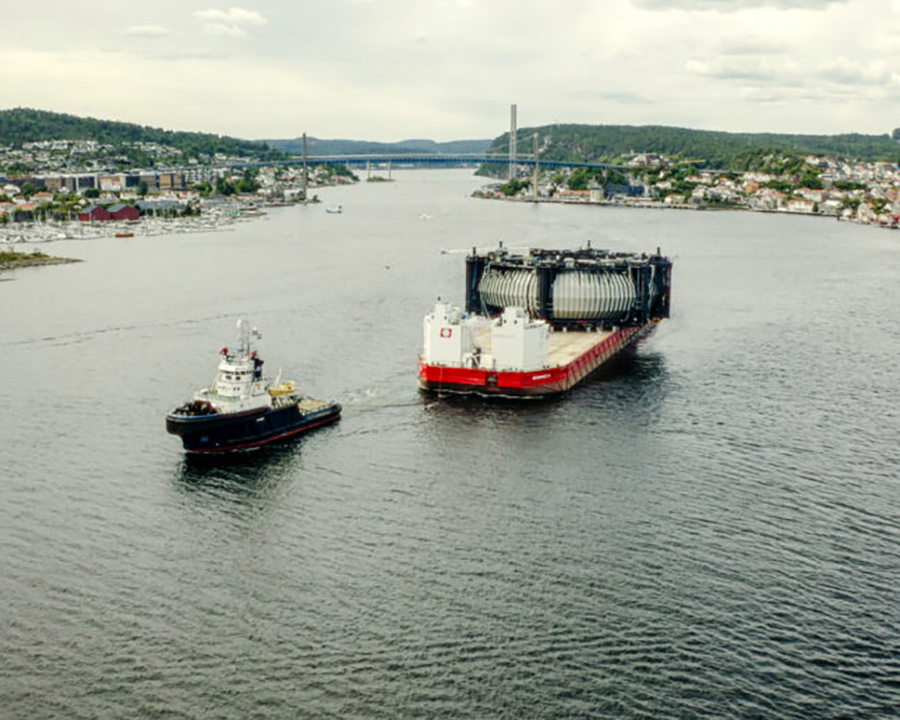
The Marine Donut on its way to the deployment site. Credit: Bluegreen AS
To facilitate the handling of the plastic sheets during installation and to reduce cutting on-site, AGRU America, Inc. manufactured them in a special custom format. On the construction site, the precise curvature of the sheets was ensured by bending them over a round formwork. Once shaped, the sheets were joined together using butt welding. The construction of the Marine Donut also uses special stiffening ribs made from black PE sheets. They are the result of a calculation based on the finite element method, which was used for the precise strength and deformation analysis of the complex geometric form.
Sustainability thanks to thermoplastics
Peter Undeutsch, head of sales at AGRU America, Inc., emphasizes the forward-looking importance of using plastics in marine applications. “The Marine Donut is a milestone in aquaculture and demonstrates the enormous potential of thermoplastics in this field. We will continue to apply our extensive experience and knowledge in plastic technology to support the development of the aquaculture industry.”
Aquaculture can contribute to nearly all of the U.N. Sustainable Development Goals, with eliminating hunger and improving health at the top of the list. www.agruamerica.com
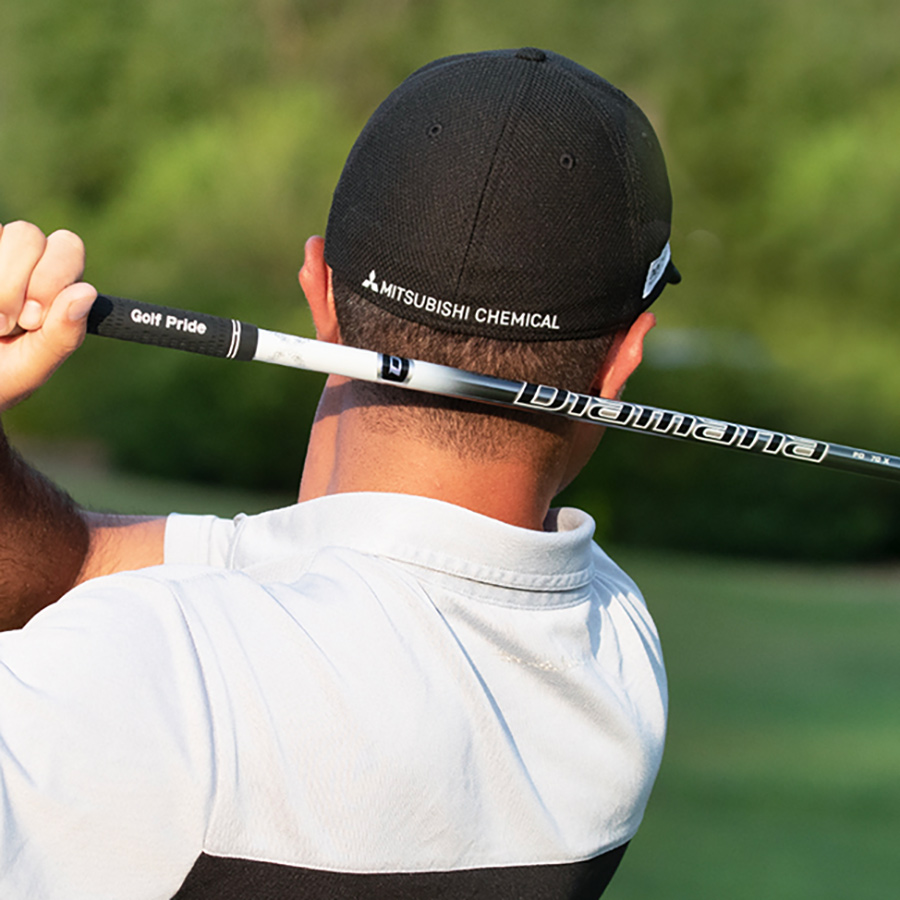
© Mitsubishi Chemical Group
Mitsubishi Chemical Group is leveraging their international Research and Development Team and work in other industries such as space exploration, commercial aviation and archery to innovate the material used in golf shafts.
Mitsubishi Chemical Group has five shaft families, TENSEI™, DIAMANA™, VANQUISH™, KAI’LI™ and MMT™. Each family of shafts has their own unique characteristics and features that are achieved with the company’s resin and carbon fiber innovations.
Resin in shafts
Mitsubishi Chemical Group’s proprietary Xlink Tech Resin System and Super Low Resin Content Prepeg (S.L.R.C.) allow for a lower resin content, at times less than 20%, and a higher carbon fiber volume to improve the feel for golfers without compromising strength or durability of shafts.
Carbon fiber in shafts
MR70 is a flagship carbon fiber designed and developed by Mitsubishi Chemical Group that is 20% stronger and has 10% higher modulus than standard materials used in shafts. Braided carbon technology is a construction technique used by Mitsubishi Chemical Group in which individual strands of carbon are braided together to increase consistency in performance over traditional sheet wrapping construction.
The TENSEI 1K Series uses a premium material, 1K carbon fiber, with a more consistent weave for a better feel throughout the swing and improved performance on the green.
Mitsubishi Chemical Group shafts are on the upswing
Mitsubishi Chemical Group’s material innovations in carbon fiber golf shafts are driven by a strong demand for lightweight clubs. Their innovations in shafts have not gone unnoticed by golfers, the PGA Tour saw an increase in Mitsubishi Chemical Group golf shafts in play by 85% and the number of TENSEI 1K driver shafts in play during the 2022-2023 season increased 700% from 2021-2022. Overall, Mitsubishi Chemical Group’s shafts have been a part of 608 wins on major tours worldwide since 2004. www.mcam.com.